
Danny Bonnett, Chair of the WindSEED JIP
The global energy transition demands a step-change in the build out of renewable energy systems and infrastructure. But this challenge isn’t only about scale. We believe that most new energy infrastructure – onshore or offshore – must be nature positive by design if we are to tackle the biodiversity crisis at the same time. The energy transition depends on healthy, diverse ecosystems, and in turn those ecosystems require a transition that restores rather than degrades nature.
The WindSEED Joint Industry Project is working to realise this vision for offshore wind. But to do that, we need clarity: what exactly is Nature Inclusive Design, and why does a common definition matter?
What Nature Inclusive Design Means
Nature Inclusive Design (NID) is defined in PAS 1401: 2025 Nature-inclusive marine structures – Code of Practice as:
"Design targeted at the integration of ecosystems, or specific habitats and species, with man-made architecture and infrastructure, via the intentional incorporation of habitat features, and backed by scientific evidence."
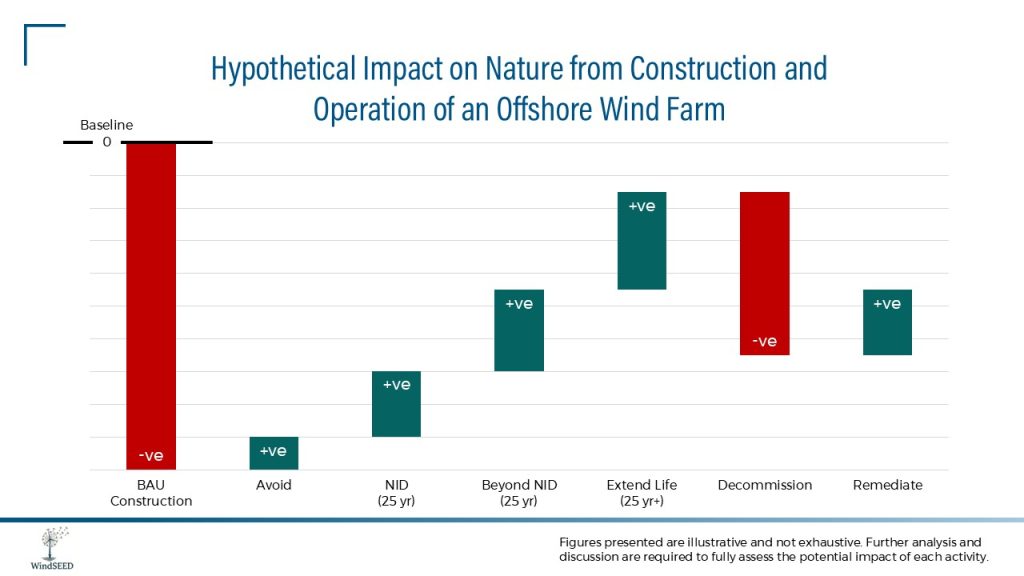
A common example in offshore wind is the use of scour protection engineered to support colonisation by native species – for example, fish, crabs or lobsters in UK waters. Here, the aim is for the NID solution to perform the same structural function as the standard approach, but with better environmental outcomes.
Put simply, NID does not add new scope. Instead, it optimises or substitutes existing components so they deliver both engineering and ecological value.
Why the Distinction Matters
Not every nature positive intervention qualifies as NID. Following the PAS 1401 definition, NID does not involve actions that go significantly beyond what would have been built anyway.
For example, Ørsted’s installation of concrete “pipe reefs” in the North Sea, designed to create hard substrate and provide shelter for species such as cod, was an innovative, regulator-backed initiative towards active nature recovery (https://www.therichnorthsea.com/project/orsted-2/).
However, these pipe reefs were intentionally deployed away from turbines and were additional to business‑as‑usual construction. As such, they go beyond NID, representing an active nature recovery measure rather than a nature-inclusive design feature.
The nature recovery achieved with the pipe reefs may go some way to offset other damage and disturbance caused to the ecosystem in the construction, operation and decommissioning of a wind farm – a positive contribution towards an overall nature positive outcome – but they may not always be permissible. If the site is classified as a marine protected area, doing anything other than minimising your damage and physical footprint will not be allowed. This is where well-defined NID becomes essential.
The Case for Getting Nature Inclusive Design Right
Addressing nature inclusivity early in the design process allows project teams to choose solutions that both reduce harm and deliver ecological benefit. But design alone is not enough. Achieving nature recovery at scale requires difficult decisions by both industry and regulators.
For example, if a protected site is already degraded due to previous activities or climate change, should we aim to simply protect the degraded baseline? Or should we consider measures that deliver wider biodiversity benefit – potentially moving conditions closer to pre-anthropogenically disturbed conditions?
These are complex questions, but they are central to building offshore wind – and other onshore and offshore energy infrastructure – that is genuinely nature positive.
Continuing the Conversation
I hope that this has sparked new thinking around Nature Inclusive Design and how it can be embedded in the projects you work on. I’m keen to hear your views on:
- whether the PAS 1401: 2025 definition of NID is sufficient
- how we go beyond NID into active nature recovery
- the risks and opportunities involved, and
- how, together, we can deliver offshore wind that is truly nature positive.
Join the conversation on the WindSEED JIP LinkedIn page.